
Image:
Evaluation:
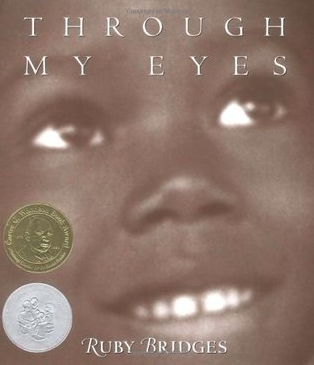
The name Ruby Bridges may sound familiar to many American citizens, but they might not know who she was and the impact she left on our country. Through My Eyes is the autobiography and firsthand account of Ruby Bridges, the little girl who took a big step and helped change the American public school system. Ruby’s insights, albeit not always so unexpected, allow the reader to step into that crucial time in history when tensions were high and integration was finally becoming real. Not only did Ruby discuss the protestors and the danger she was in every day she went to William Frantz Elementary School, but she touched on the other brave children and their families who dared to integrate. She shared facts about her life, as related to the civil rights movement, from her birth all the way through to her adulthood and having a family of her own. Some of these facts were eye-opening, especially if the reader was not alive during that time.
The precise vocabulary used in this retelling allows the reader to feel what Ruby felt during certain times of her life. Ruby Bridges describes her distinctive school career and shares her thoughts and feelings about everything going on as if she were a child again. She even expresses some thoughts she remembers having during the time of the civil rights movement. One example of this is when she shares about how weird it was that she was the only girl in her class, implying that none of the other white classmates were being allowed by their parents to come to an integrated school. The language Ruby Bridges uses to convey her childhood feelings helps the reader empathize with her.The precise vocabulary
Along with insights and precise vocabulary, Bridges uses understatement to get her points across effectively. She doesn’t have to overstate or sensationalize anything because the story itself is riveting enough. The circumstances and events that actually happened in Ruby’s life speak for themselves. Children are fascinated by events that took place before their births, especially ones that have shaped our society as much as the events of Ruby’s life.
Response:
Even though this was an amazing look into the life of a civil rights icon, I felt it could have had a little more appeal to it, especially as a children’s book. The story itself is absolutely fascinating, but the writing could have used something else to pull in the reader. It took really searching for the elements of a well-written book to see the merit behind the writing. Ruby’s detailed narrative explained things that no one else could have known, but to me it still read slightly like a school textbook. There wasn’t anything about this book that changed my personal viewpoints. Thankfully, I was raised with an awareness and condemnation of racism and desegregation. Also thankfully, I never had to live through that. Reading Ruby’s story only widened by frame of reference and strengthened my perspective on that time period.
Conclusion:
The autobiography of Ruby Bridges is an insightful, well-written picture of a time that was so important in our nation’s history. Ruby’s childlike perspective of the events that occurred during the very beginning of integration can be a great way to help young children understand the significance of her first grade year at William Frantz Elementary School. This would be a great place to start a lesson during Black History Month or just to start a conversation on racism and its history in the United States.
Citation:
Bridges, R. (1999). Through my eyes. New York, NY: Scholastic Press.

 Mrs. Day's Summer Reading Blog