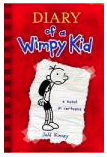
Diary of a Wimpy Kid (Book #1) by Jeff Kinney – Graphic Novel

Image:

Evaluation:

Jeff Kinney’s Diary of a Wimpy Kid is written in diary entry style from the perspective of a boy just trying to survive a year of middle school. Don’t try to call it a diary though, it’s a journal according to Greg, the narrator. Kinney starts off the book by drawing a line in the sand about this book not being a diary, however, the title clearly states that this is a diary.

Kinney doesn’t really use any character-revealing dialogue in the book besides Greg’s inner monologue about his life’s daily events. But that monologue does reveal quite a bit about Greg’s character. Greg is absolutely clueless when it comes to being a good friend or being a good person in general. He pretty much focuses on himself and cares very little about anyone else. Kinney also doesn’t use very precise vocabulary, figurative language, music in language, understatement, or any unexpected insights. Greg learned nothing from all of his “misadventures.”

Kinney’s illustrations reinforce the text fairly well with small drawings that either match the text or expand it slightly. In one instance, Greg is picked on for his sewing skills he learned in Home Economics and the picture shows a bully calling his embroidered book bag a purse and then teasing him for carrying a purse. That’s about all the illustrations do for this book.

Response:

Personally, I think this book is awful. I didn’t laugh one bit. I was actually excited to finally read something I knew so many of my students had read and enjoyed. That was killed when I read it. I kept hoping it would get better and that Greg would actually learn that everything bad happening to him was really his own doing. Never happened. Honestly, I think Greg, his dad, and his older brother have personality disorders. They’re mean and completely lack any kind of empathy for anyone but themselves. Then there’s the obvious bullying going on at the school that none of the adults seems to know or care about. Greg’s poor friend Rowley keeps getting taken advantage of and even hurt by Greg, but I couldn’t even feel that bad for him because the only time he ever did anything to prevent it was when he stopped talking to Greg for a little bit. I was just so sorely disappointed by this book. I really, truly have no idea why it is so popular. I struggled to find good things to evaluate it on. I would consider this a dumpster fire of a book with the rampant bullying, narcissistic behavior, slight homophobia (Christmas with the dollhouse and Barbie), and maybe even hints at an abusive father (possibility of getting a brick thrown at his head?). I’m appalled that my students read junk like this. No wonder behavior in schools seems to be getting worse. I can’t say I would stop anyone from reading it, but I would try to make sure that it was known that Greg’s behavior is not normal or acceptable. For my own future children, this could be a lesson on how not to act.

Conclusion:

Jeff Kinney’s Diary of a Wimpy Kid is a diary-like story about a boy just trying to survive a year of middle school. Kinney uses a slight line drawn in the sand and does reinforce his text with his illustrations but that’s about all this book has going for it. I don’t recommend this book for anyone really unless you plan on teaching children how not to act.

Citation:

Kinney, J. (2007). Diary of a wimpy kid. New York, NY: Amulet Books.
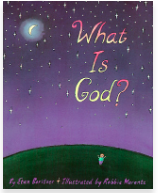
What is God? by Etan Boritzer, Illustrated by Robbie Marantz – Christian

Image:

Evaluation:

Etan Boritzer’s What is God? is a surprisingly diverse picture book about religion and the concept of God. The unexpected insights definitely make this book stand out. Bortizer bravely writes about topics that conservative religious families might not discuss with their children like what the major religions with one deity are called, what they read from, and where they go to pray. He also touches briefly on countries with multiple deities and countries where they are not allowed to pray or even talk about God. In the end, Boritzer makes the assertion that God is in everything and that praying could bring us closer to answer the question: What is God?

Robbie Marantz’s illustrations for the book reinforce Boritzer’s text. There is a page of illustrations to match each page of text throughout the entire book. Most of the time it follows a boy and his dog in scenes that would pertain to the main topic of that page of text. However, there are a few pages that show other things such as the examples of all of the religious texts. The illustrations definitely match where the text is going.

The illustrations didn’t do much else besides reinforce the text. They did not establish a setting, provide interesting asides, define characters, extend the plot, establish mood, nor did they provide a differing viewpoint. For such an interesting book, the illustrations fell short.

Response:

When I first began reading this book, I was slightly bored but could see the benefit in reading it to young children. Then, suddenly out of nowhere, the author discusses the various major world religions. My interest piqued. I was fully prepared for a one-sided viewpoint of Christianity’s answer to the question, “What is God?” I did not foresee the information taking that turn. I’m delightfully surprised that there is such a diverse children’s book on religion. When I was young, I did not know about anything other than Christianity really. I had heard of the others, but never really knew anything about them. It wasn’t until high school when I took a class that made me research some core principles of each of the major religions that I understood that not all other religions are terrible. I loved how that class taught me tolerance and I love how this book can teach tolerance. I’m even tempted to buy it and keep it around to read to my own children.

Conclusion:

Etan Boritzer’s What is God? is an astonishingly diverse perspective on religion for children. It is refreshing to see a book on a Christian list that delves into other religions without being hateful or shunning them, ad from so long ago too. I recommend this book for parents who want to teach their children about God and praying and who also want their children to grow up tolerant of other religions.

Citation:

Boritzer, E. & Marantz, R. (Illustrator). (1990). What is god? Buffalo, NY: Firefly Books. Ltd.

Can I Be Your Dog? by Troy Cummings – 2×2: Age 2 through second grade

Image:

Evaluation:

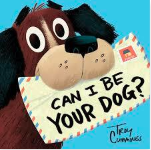
Can I Be Your Dog? by Troy Cummings is a heartwarming, albeit slightly silly, little tale about a dog who just wants to find a home. Arfy is apparently a literate dog who writes letters to every house on Butternut street, hoping to find a home and a family. Unfortunately, he is shot down by pretty much everyone until a special person turns the tables and asks Arfy if she can be his person. Cummings’ illustrations for this book reinforce the text as they usually do in picture books. Each house or business Arfy writes to is shown on the page with his letter to them, then his reaction to each rejection letter as well.

A fun aspect of Cummings’ illustrations is that he does provide some interesting little asides through the mail carrier that delivers all of Arfy’s letters. With the first letter, she delivers it normally, but with the second the reader can see her reading Arfy’s note as it is not in an envelope. With the third letter, she is shown thinking while she reads what Arfy wrote. Then concern washes over her face delivering the fourth letter to the grumpy “Junkyard Guy.” All of these little asides foreshadow the mail carrier asking Arfy is she can be his person in the happy ending of the story.

Unfortunately, the text is where this book falls flat. It is told entirely through letters and does not use any interesting techniques. I would even go so far as to say that is slightly didactic with its message of adopting dogs and feeling sorry for homeless animals. There is a note at the very end of the book about adopting shelter animals, volunteering or even donating to shelters.

Response:

The first time I read Can I Be Your Dog? was at a school book fair. I’m a teacher and I was perusing the new books at the book fair sneak peek at my school when I saw it. I read the whole thing in a few minutes and instantly started tearing up when the mail carrier asks Arfy if she can be his person. This book got me real good. I am an animal lover and I do feel sympathy for all those babies in shelters or on the streets without homes. So of course I bought the book. I will say that I don’t think it has a lot of meat to it and it’s not really all that of a literary accomplishment, but I still enjoyed it. Any book or movie that can make me cry like that is still worthy of my money. It lays the guilt on pretty thick and definitely makes me want to go adopt a dog.

Conclusion:

Can I Be Your Dog? by Troy Cummings is a cute and silly story about a puppy trying to find a home. The illustrations are appropriate and interesting even if the story itself is a little didactic. I would recommend this book for parents with young children who either already have a dog or are planning on getting one very soon. I would also recommend it to shelters with reading programs or libraries with reading to dog programs. I do not recommend this book to someone who cannot get a dog in the near future. It will just cause that reader heartache.

Citation:

Cummings, T. (2018). Can I be your dog? New York, NY: Random House Children’s Books.

The Adventures of Beekle: The Unimaginary Friend by Dan Santat – Caldecott Winner 2015

Image:

Evaluation:

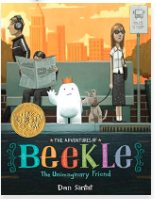
Dan Santat’s The Adventures of Beekle: The Unimaginary Friend is a charming story of an imaginary (or unimaginary) friend who has yet to meet his real life child counterpart. Beekle, growing impatient, goes on an adventure to find his friend in the real world and thankfully, eventually meets Alice. The precise vocabulary in this story causes the reader to think about the meaning of the word “imaginary.” Santat only uses the word once, at the very beginning of the story to describe Beekle. After Beekle sets off to find his friend, the prefix “un-” is added, changing the tone of the book. From then on, Beekle (and eventually his friend Alice) accomplishes the “unimaginable.”

Santat’s illustrations in Beekle really make this book exceptional. The text is reinforced through his illustrations. Santat shows what the island where the imaginary friends are created looks like before Beekle sets off to the real world. The reader gets to the see the other imaginary friends and when some of them are imagined by their friends. Santat shows what Beekle imagines his friend is doing instead of imagining Beekle into the real world. The reader not only gets to see the “dangers” Beekle faces on his journey, but the harbor and streets of the real world when Beekle arrives. Then Santat shows the playground where Beekle goes to find his friend and eventually the tree where they meet. Finally, he shows the fun things Beekle and Alice get to do together, including when another child with his imaginary friend want to come play with them.

The illustrations in this book also establish the mood beautifully. The vibrant colors in the land of imaginary friends starts the book off with hope and happiness. Until Beekle realizes his friend is taking forever to imagine him and he decides to set off to find them, which is when the pages turn monotone. Then when Beekle arrives in the real world, it is gray, white, black, and bleak.The mood switches gears once again when Beekle notices another imaginary friend walking by in bright blue and decides to follow it to a wonderfully colorful playground, showing hope once again. As Beekle continues to search and he begins to lose hope again, the pages begin to mute. Then, when he finally meets Alice and they quickly become friends, the dynamic colors once again flood the pages to bring a sense of happiness.

Response:

The Adventures of Beekle: The Unimaginary Friend is a sweet picture book. It reminded me of childhood innocence with all the ups and downs of making friends, imaginary or not. The warmth this book emitted as I read it made me want to be a kid again. I think young children would be able to identify with Beekle and Alice both, but I don’t think children much older then ten would appreciate its childish theme. Though, I do think it is a good reminder for adults that child have wonderful imaginations that need not be squashed. Beekle’s viewpoint of the real world (before he reaches the playground) is exactly what is so terrible about growing up. No one stopped to listen to the music and everyone was tired. How sad. I think this book is a great reminder to let kids be kids. So what if they have an imaginary friend? Maybe they need it. We shouldn’t make kids grow up so fast. Many adults end up missing childhood, so they have kids or they work with kids (like me). Hidden moral of this story: childhood is precious, keep it that way.

Conclusion:

Dan Santat’s The Adventures of Beekle: The Unimaginary Friend is an adorable story of an imaginary friend and the girl who becomes his real life friend. Santat’s vocabulary and colorful illustrations make this book a delightful reminder to let kids be kids, even if that means letting them enjoy an imaginary friend. I would recommend this book for parents with young children and lower elementary school teachers for read alouds. Cute story, great message.

Citation:

Santat, D. (2014). The adventures of beekle: The unimaginary friend. New York, NY: Little, Brown Books for Young Readers.

Dreamers by Yuyi Morales – Pura Belpre 2019 Illustrator Award Winner

Image:

Evaluation:

Dreamers by Yuyi Morales is a beautiful expression of wonder and hope from the perspective of a single, young, immigrant mother traveling to the United States with her infant son. The precise vocabulary that Morales uses was simple, yet powerful. There isn’t a whole lot of text throughout the book (until the very end when she explains her story) but when there is, it is effective. She uses advanced English words like “resplendent,” and advanced Spanish words like “soñadores,” but knowing her reader she placed this word next to its English translation: “dreamers.” Then at the end of the book, two pages are dedicated to explaining the story of her immigration and her discovery of the American library system. Her words are filled with emotion so that the reader feels empathy for her.

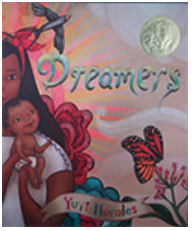
Morales’ illustrations in Dreamers are absolutely captivating. They first and foremost establish the mood of wonder and hope. The vibrant colors and attention to detail paint such a picture of emotion. The few pages where Morales seemed uncertain of her path and this foreign country that she and her son have entered are more muted and cloudier than the others. The reader can tell when she begins to feel more comfortable and trusting because the colors begin popping out again.

The illustrations also extend the plot. As stated earlier, the text is minimal throughout most of the book so the reader must rely on the illustrations for much of the story. Beginning with what Morales packed in the bag she brought to the United States, the illustrations show other things the text would not, such as things the English speakers said to them, how she got in trouble at one point, what she saw while they walked, and then most importantly the imagination from all the stories she read with her son, Kelly.

Response:

I was blown away by Dreamers. It is a beautiful book filled with emotion. This story really is a different perspective from what you can see and hear in the media about immigrants from Mexico. I know this took place almost 30 years ago, but immigration issues are so prevalent right now that it makes this book all the more meaningful. Even through all her hardships and confusion, Morales kept hopeful and kept dreaming throughout her journey. It really makes you think about all these people trying to come to the United States and what they must be going through. And yet they still come. Morales doesn’t really touch too much on her life in Mexico, except that she didn’t expect to stay in the United States. I wonder if she ever felt like one was better than the other or if she ever thought about going back to live in Mexico. Seeing this perspective didn’t really challenge my view of immigration, as I feel like I am constantly in a state of perplexity about how I feel for these poor people. I still don’t know how to feel about these immigrants because I don’t really know what they are running from when they come here. All I know is that our country is very divided on this issue and I’m not sure what will bridge that divide.

Conclusion:

Dreamers by Yuyi Morales is an exquisite expression of the thoughts and feelings of one young, immigrant mother as she travels from Mexico to the United States to be with her son’s father. The precise vocabulary and emotional illustrations convey a theme of curiosity and promise that could be beneficial to our current society’s view on immigration, specifically to the United States from Latin countries such as Mexico. I would recommend this book to all ages. It’s just a beautifully written and illustrated picture book.

Citation:

Morales, Y. (2018). Dreamers. Toppan Leefung, Dong Guan City, China: Holiday House.

American Born Chinese by Gene Luen Yang, Color by Lark Pien – Michael L. Printz Winner 2007

Image:

Evaluation:

Gene Luen Yang’s American Born Chinese is an intriguing graphic novel beginning with three stories and ending with only one. Yang artistically weaves together the three initially separate stories of the Monkey King, Jin, and Danny. The reader is taken on a wild ride in this story and left with some profound and unexpected insights. The main character, Jin/Danny, goes through an identity crisis as he grows up with Chinese heritage in a very white-American setting. He tries to blend in with his surroundings so much that he ends up hurting a friend and losing himself. The Monkey King helps him realize his mistakes and reconnect with his conscience in a very unexpected, and slightly religious way.

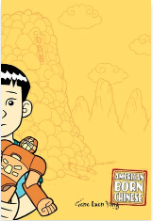
Yang and Pien’s illustrations establish the setting for each of the different stories. Each chapter has a red stamped face of the character that chapter focuses on. The words in the story do tell where the setting is some of the time, but there are times when the reader must rely on the illustrations, such as when Jin is moving in the very beginning of the story. The moving boxes in the car and Jin’s sad facial expressions are the clues that his family is moving to a new place that Jin is not sure about yet.

The illustrations also define and develop the characters in American Born Chinese. Jin undergoes some transformations, physically and emotionally, as foreshadowed by the herbalist’s wife when Jin was younger. These transformations are shown in two parts: Jin turning into Danny and then back into Jin again. The Monkey King also transforms quite a bit throughout the story as he at one point masters the Kung-Fu major bodily form discipline of shape-shifting. This is key to his story as it intertwines with Jin’s.

Response:

American Born Chinese was a wild ride of a read for me. Yang did use foreshadowing, but I was still amazed at every new twist and turn. Being from the very white-American side of things that Jin so desperately wants to be apart of horrified me to see how Jin, Suzy, and Wei-Chen were treated by the white Americans. Unfortunately, racism is still very common in America today so it is sad, but understandable that Jin wanted to hide his heritage and blend in with the white Americans. I did not expect all the twists and turns this book has to offer. I knew the three stories of Jin, Danny, and the Monkey King had to be related, but I couldn’t figure out how until the connections suddenly revealed themselves. I thought the ending was happy, but it still let me wanting to hear more about Jin and Wei-Chen. I was left hoping they would rekindle their friendship and that Wei-Chen would return to his test of virtue and become an emissary of Tze-Yo-Tzuh like his father, the Monkey King. Another thing that surprised me was the alluding to the Christian story of Jesus’s birth with the three wise men. Part of the Monkey King’s story is that he himself was actually one of the wise men bringing gifts to the baby Jesus. This surprised me because I would not have expected Christian themes in a book about Chinese-American people, plus the Monkey King really seemed to be from another religion altogether. This goes to show how much I do not know about the blending of cultures in America.

Conclusion:

Gene Luen Yang’s American Born Chinese is a surprisingly insightful graphic novel. Yang expertly entwines three different stories to teach a lesson on being yourself while also subtly promoting religious virtue. I would recommend this book for middle and high schoolers, especially those interested in Chinese-American culture. It is definitely a fascinating and thought-provoking read.

Citation:

Yang, G. L. & Pien, L. (Color). (2006). American born chinese. Dongguan City, Guangdong Province: RR Donnelley Asia Printing Solutions Ltd.

The Magic Misfits by Neil Patrick Harris, Illustrated by Lissy Marlin and Kyle Hilton – Mystery/Suspense

Image:

Evaluation:

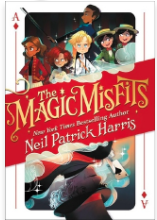
Famous actor, Neil Patrick Harris’s The Magic Misfits is the first of a three-book series. This is a heartwarming story about a boy named Carter running away from a bad situation living with his uncle. Carter meets a band of kid magicians and adventure, of course, ensues. The dialogue in this story reveals much about its characters, but sometimes leave the reader curious about their pasts. Two characters that Carter meets along the way, Mr. Vernon and his adopted daughter Leila, both have their fair share of secrets. Near the end of the story, the reader discovers that Mr. Vernon knew more than he let on throughout the book. However, Leila’s responses to Carter’s questions reveal that she still has some secrets about her past. This leads the reader to want to read the next book in the series to find out just what happened to Leila before Mr. Vernon and his husband adopted her.

Unfortunately, Neil Patrick Harris’s condescension through explaining vocabulary and slight overstated onomatopoeia detract from the story. The condescension did eventually taper off, but in the beginning, it was prevalent enough to break up the story and annoy the reader. This could be off-putting enough to have one put the book down and never finish it. The onomatopoeia was only slight, thankfully, but it was still unnecessary.

Lissy Marlin provided some illustrations throughout this novel which simply reinforce the text. It was nice to be able to see what most of the characters looked like even if the illustrations were black and white. Kyle Hilton, on the other hand, provided illustrations for the magic tricks taught sporadically. This was a delightfully unexpected addition to the book that might keep kids coming back to reread the story and try their own magic tricks.

Response:

Honestly, at first, I had a hard time getting through The Magic Misfits with the frequent condescension. Thankfully, that subsided and I could appreciate the story more. I enjoyed Neil Patrick Harris’s “breaking the fourth wall” and talking to the reader. I think 10 year old me would have enjoyed it as well. It is very much so aimed at the eight to twelve-year-old range with that aspect, which is fine in my opinion. The story itself is cute and heartfelt. It leaves the reader wanting to know more about the characters’ backstories, but it also works as a stand-alone book. I did also like the message Harris stuck to throughout the story about not stealing, even when you had nothing and might not even be able to eat. That’s a good message for young people, such as the target audience for this book. The magic tricks spread throughout are fun and interesting as well, but they don’t really follow the story and do kind of unnecessarily break the text up. I wanted to try a few of those tricks myself but kept reading instead. I might go back and try one of them still.

Conclusion:

The Magic Misfits by Neil Patrick Harris is the first of a three part series about a band of kid magicians. It’s a mystery leaving the reader with most questions answered, but not all. This heartwarming tale is aimed at elementary school students with a sense of adventure. The story’s dialogue and illustrations might help the reader overlook the condescension in the beginning in order to the get to the meat of the story and the suspense of the mystery. Like a good magic trick, this story leaves you guessing until the very end. It’s definitely appropriate for the age group it is written for, but I would not recommend it for anyone older.

Citation:

Harris, N. P., Hilton, K. (Illustrator), & Marlin, L. (Illustrator). (2017). The magic misfits. New York: Little, Brown and Company.

Scary Stories to Tell in the Dark collected by Alvin Schwartz, Illustrated by Brett Helquist – Horror

Image:

Evaluation:

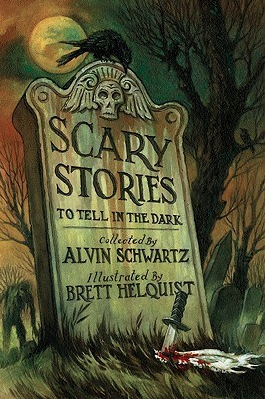
Alvin Schwartz’s Scary Stories to Tell in the Dark is actually a collection of short, creepy folktales. Schwartz provides variants to the stories and their sources at the end of the book. Throughout some of the stories, but not all, Schwartz uses musical language that adds a layer of creepiness to his tales. Some of the stories even have tunes to go with them. If the reader is not able to read music, there are several versions of each available to listen to online, though the lyrics may not be there same. These lyrics were tamed down for children it seems. Other stories in the collection include rhythmic repetition of words or phrases that may or may not be uttered by the dead. Creepy!

Brett Helquist’s illustrations for each story mostly reinforce the text, though in some cases they help the reader make predictions. There is only one illustration per story and it’s always in black and white, however each one does illuminate a certain aspect of each story. In the story The Hook, the picture is that of a hook, obviously belonging to a hand, that is detached and hanging on to what it seems is a car door. The story reveals that an escaped murderer with a hook for a hand is on the loose and at the end of the story that detached hook is found hanging from the car door of the main characters. The reader can easily predict what will happen from the picture, or at least make the connection between the text and the illustration.

Neither the illustrations nor the text had any other noteworthy qualities. The text did include dialogue, but in most cases it did not reveal anything about any characters. One could even say that there was some overstatement in the moans and groans of some of the ghosts or spirits. This was meant to enhance the creepiness of the tales but only does so when the story is read aloud with good voices. The illustrations were too few and far between to leave any other impressions.

Response:

I remember my elementary school librarian reading a few of these stories to my classmates and I. Then of course we all checked out the books so we could read them in the creepy voices. Now, a movie is coming out! An old elementary school classmate told me about it and we gushed about how we wanted to see it because we loved the books as kids. However, I will say, in rereading Scary Stories to Tell in the Dark I have unfortunately determined the stories to be not actually that scary. I am reminded of how different a child’s view of what is scary can change drastically as they grow up and their perception of the world changes. I also have to remember that folktales are from a different time and what may have been scary when it was written, may not be scary anymore. I am pleased though that they have found a way to make the movie for these stories look scary. I’m excited to see it!

Conclusion:

Scary Stories to Tell in the Dark is a creepy little collection of folktales in which Alvin Schwartz uses musical language to heighten the fright. The illustrator, Brett Helquist, reinforces each story with only one picture to represent the text. Overall, I would say that this is not the scariest book I’ve ever read, but then again I’m not a child anymore. Also, either the writing or the illustrations could be given a boost in order to make the stories more interesting. The success of this book depends on the reader, especially if it is read aloud.

Citation:

Schwartz, A., & Helquist, B. (Illustrator). (2007). Scary stories to tell in the dark. New York, NY: HarperCollins Children’s Books. (Original work published in 1981).

Smile by Raina Telgemeier – Graphic Novel

Image:

Evaluation:

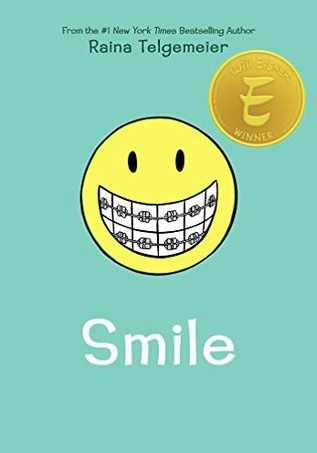
Smile is Raina Telgemeier’s true story of her teenage years in the early 90s. As graphic novels can go, this surprisingly quick read is a page turner. Raina’s physically painful battle with her teeth and orthodontia plus the emotional agony of going through puberty makes this tale relatable and interesting. Telgemeier’s insights, some expected and some not, come naturally as Raina navigates middle school and beyond. From an accidental injury that ends up changing her smile forever to realizing that her group of friends are actually really awful to her, Raina learns some valuable life lessons.

Considering the Raina in the story wants to be an animator and if often seen creating, it makes sense that Telgemeier is the illustrator for this novel. The illustrations first and foremost reinforce the text. Raina’s physical appearance changes as she grows and her teeth show their painful transformation with each new “-ontist” visit. The illustrations also portray the characters’ reactions and feelings quite well revealing traits that may not have come through as well in a regular young adult novel.

Not only do these illustration reinforce the text, but also extend the plot. There are many instances when the frame of illustration has no text at all, just a scene or a face with a reaction. Where in text it may have taken several sentences to describe a character’s reaction to an event, in this graphic novel only one or two frames has to ability to show the same thing. An example of this is when Raina meets Sammy. She thinks he’s cute but is afraid to smile at him due to her new, oddly shaped braces. In one frame, Sammy smiles and shows her braces and Raina slightly smiles back revealing that she is now more comfortable with Sammy. Unfortunately, the reader finds out later that Sammy and Raina are not meant to be.

Response:

Smile is extremely relatable. Even if it does take place in the early 90s, when I would have been just a toddler, the situations she finds herself in and the emotions she feels evoke so much empathy. I actually had a close friend do something very similar to her two front teeth at my house when we were younger. She now has two fake implants instead of going through all the experimental orthodontia that poor Raina has to go through. Raina’s friends throughout the first three quarters of the book also had me in fits. I kept stopping the book to tell my husband about all the awful things they did and said to her. I was thankful when she finally called it quits with them and moved on. She found much nicer friends that way who actually helped to to see that she didn’t have to be ashamed of who she really was. A lot of teens and preteens can relate to this theme, including myself at that age. It’s a universal truth that not everyone is going to be a good friend and sometimes we outgrow the immature people that we used to have so much in common with. This book resonated with me, but did not necessarily change any of my views or opinions. If anything, it strengthened them.

Conclusion:

Smile by Raina Telgemeier is an insightful, well-illustrated graphic novel. The themes of accepting yourself and choosing your friends wisely shine through with the dialogue and illustrations that not only reinforce the text, but actually extend the plot well. This is a book I would recommend to any girl, or boy, from upper elementary all the way through high school. It’s a great way to show teens or pretees that everyone is a work in progress and that you don’t have to put up with people who don’t make you feel comfortable.

Citation:

Telgemeier, R. (2010). Smile. New York, NY: Graphix.

Esperanza Rising by Pam Munoz Ryan – Historical Fiction

Image:

Evaluation:

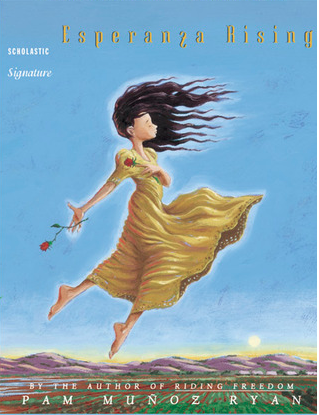
Immigration, working conditions, and racism are prevalent issues in US politics currently and have been on and off since the beginning of our nation. Pam Munoz Ryan’s Esperanza Rising is the fictional story of a girl who grew up affluent in Mexico during the time of the Great Depression. Sudden tragedy forces Esperanza and her mother to flee to the United States where they must work in a camp for Mexican farm workers just to survive. The unexpected insights in this book are deeply felt as the reader follows Esperanza and her mother on their journey to a new place and a new state of mind.

Something that sets this book apart from others is the language. Ryan’s figurative language adds layers of meaning to this already insightful story. Esperanza’s Abuelita, Mama, and other close friends frequently remind her of old Mexican adages about life that help ease her transition from born wealthy to working poor. These little life lessons aid in Esperanza’s transformation from a helpless, pampered child to a resilient, hard working asset to her new community.

Ryan’s precise vocabulary is the final ingredient in making this book captivating. There is not only a variety of English words and phrases, but Spanish as well. Each chapter is named after a food that can be grown, fruits or vegetables, but the word is both in English and Spanish. The fruit or vegetable name of each chapter usually plays a part in that chapter. At the end of the book, Esperanza measures the year since her father’s death in the fruits and vegetables, instead of months. This is not the only place you can find Spanish words or phrases; they are sprinkled throughout the book. Thankfully, English translations are either nearby or there are enough context clues for those of us who do not read Spanish. The effect of this is the reader immersing themselves in the Mexican/American world that the characters are living in. This can be a special thing to see for readers who speak both languages.

Response:

I actually began reading Esperanza Rising earlier this year because a teacher-friend of mine was reading it with her fifth grade class and I borrowed an extra. Immediately, the sudden loss of Esperanza’s father sucked me into the story. I couldn’t help but continue to read to find out what happens to the main character and her family. While I can’t personally relate to many of the characters’ plights, the issues brought up in this book are familiar to me. I have seen immigration, workers’ conditions, and racism as still very much in the forefront of our media today. Racism has been in the news with regards to police, workers’ conditions with regards to teachers, and immigration with regards to the wall that is trying to be built between us and Mexico. I find it interesting and sad that these issues were happening then and still happen today, almost 100 years later. Still, the book is another that tugged at my heart strings and really caught and kept my attention.

Conclusion:

Pam Munoz Ryan’s Esperanza Rising is a beautiful fictional tale set in actual historical times in both Mexico and the United States. Ryan’s insightful use of figurative language and precise vocabulary, in both English and Spanish, reveal Esperanza’s developing character and the themes of perseverance even when you have to start over. Wonderfully written and powerful story, would definitely read again!

Citation:

Munoz Ryan, P. (2000). Esperanza rising. New York, NY: Scholastic Press.